60+ Vision Board Ideas for 2026
Most vision boards end up in a drawer by February. Not because the goals weren't real — but because the board was built on vibes rather than structure. Random pretty images don't give your brain enough to work with.
This guide takes a different approach. You'll get a clear category framework, 60+ specific image ideas organized by life area, a full list of title options, a dedicated section for students, and a practical method for generating custom images using AI — including copy-ready prompts for each category. Build one you'll actually look at.
Quick Answer: What should you put on a vision board? Cover 4–6 life areas: health, career, finance, relationships, personal growth, and travel. Use specific images (a named destination, a dollar amount, a real fitness goal) rather than vague symbols of success. Add a title that captures your identity for the year. Keep the total under 12 goals. Place it somewhere you'll see it daily — phone wallpaper works better than a wall poster you stop noticing.
What Is a Vision Board?
A vision board is a visual collection of images, words, and goals that represent the life you're working toward. It's not magic — but the science behind it is real.
Your brain has a filter called the reticular activating system (RAS). When you repeatedly see a goal, your RAS starts surfacing related opportunities and cues you'd otherwise tune out. Consistent exposure reshapes what your brain notices and prioritizes. That's why a board you see twice a day outperforms one you made once and forgot.
The 6 Core Categories
The most effective vision boards aren't random collages. They cover multiple life areas so your goals feel balanced, not one-dimensional.
| Category | What It Covers | Example Image Type |
|---|---|---|
| Health & Wellness | Body, energy, mental state | Morning routine flatlay |
| Career & Business | Work, growth, professional identity | Dream workspace |
| Finance & Abundance | Money, security, financial milestones | Savings tracker planner |
| Relationships & Love | Romantic, family, friendships, community | Friends laughing at dinner |
| Personal Growth & Mindset | Identity, habits, inner work | Open journal with notes |
| Travel & Adventure | Experiences, freedom, exploration | Destination landscape |
Supplementary categories worth adding: Home & Lifestyle, Creativity, Spirituality. But start with these six. Aim for 2–3 images per category and keep the total under 12 items.
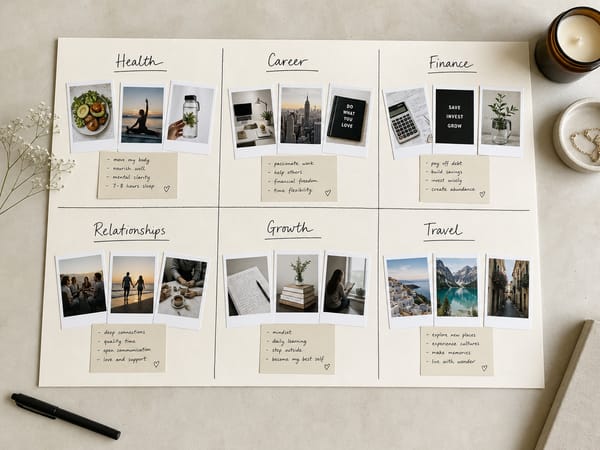
Somake prompt:
Flat lay of a vision board divided into six labeled sections — Health, Career, Finance, Relationships, Growth, Travel — arranged on a light beige surface, minimal design, hand-lettered section titles, small polaroid-style photos in each section, top-down view, natural daylight, clean editorial aesthetic
Where to Start
Before diving into ideas, spend two minutes on this. It determines whether you build a focused board or an overwhelming one.
Ask yourself three questions:
Where is the gap biggest right now? The life area with the most frustration or stagnation gets your first two slots. Don't spread equally across all six — weight toward what actually needs attention.
Have you made a vision board before? If yes: identify which last year's goals didn't move, and consider whether they belong on this year's board — or whether they're not actually your goals. If no: pick two categories maximum and go deep on those.
Is this board for daily motivation or long-term vision? Daily motivation → choose goals achievable this year, use vivid emotional images. Long-term vision → include 3–5 year aspirations, use identity language over specific milestones.
Your answers give you a priority order. Build the board from there.
Health & Wellness Ideas
This category works best when it's specific. "Be healthier" has nowhere to go visually. "Run a 10K in April" does.
Ideas to include:
A photo of a specific fitness goal in action — not a model, ideally someone doing exactly what you want to do (a trail run, a specific yoga pose, a weight on a barbell)
An image capturing the morning routine you want to build: a journal, a water bottle, natural window light
A photo of foods you genuinely want to eat more of — bright bowls, farmers market produce, not a stock photo salad
A word or phrase that captures how you want to feel: "strong," "rested," "10,000 steps daily"
A visual representing mental health: a calm therapy room, a meditation cushion, a solo walk in nature
A concrete sleep goal: "8 hours" written as a clear anchor
A movement milestone with a date: "half marathon — October 18"
A hydration or nutrition habit stated simply: "cook 5 dinners at home per week"
What to avoid: generic gym photos that feel aspirational but not personal. The more it resembles your actual life, the stronger the pull.
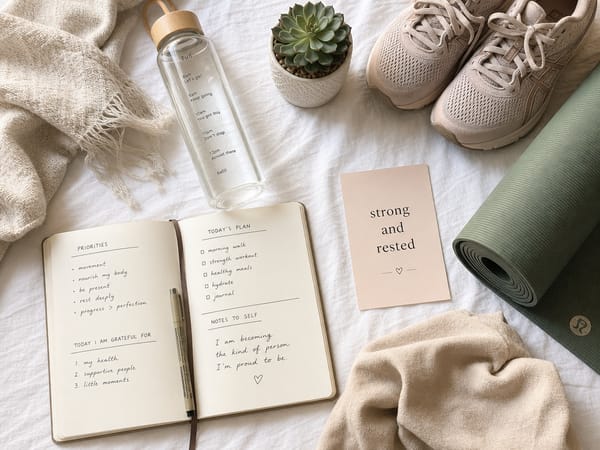
Somake prompt:
Morning wellness flat lay on a white linen surface — open journal with handwritten notes, glass water bottle, running shoes beside a yoga mat, small succulent, affirmation card reading 'strong and rested', soft natural window light, warm neutral tones, top-down view
Career & Business Ideas
Whether you work for a company or run your own, this category needs concrete visuals — not abstract success symbols.
For employees:
Your target title written out clearly — not "senior something," the actual title
A photo representing the company type, industry, or environment you want
A skill you're developing: a course certificate, a language or tool you're learning, a speaking stage
Your income goal written as a number, not a feeling
An image of someone in a leadership role that resonates with who you want to become
A work-life balance visual: a "logged off at 5pm" note, a midweek afternoon walk
For entrepreneurs and freelancers:
Your brand aesthetic: colors, fonts, the visual feel of your future business
A product mockup or service visualization
A revenue milestone styled like a dashboard screenshot
A launch moment: an email going out, a "sold out" tag, a site going live
Your dream workspace — whether that's a home studio, a co-working space, or a café with good wifi
The rule: every career image should make you think "that's where I'm going," not "that looks nice."
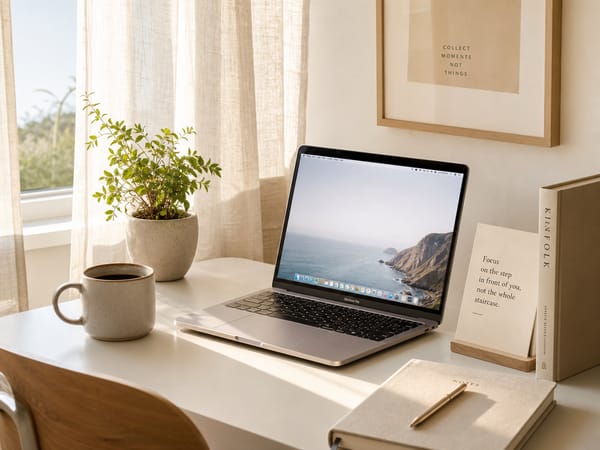
Somake prompt:
Minimalist home office desk setup — MacBook open, small potted plant, ceramic coffee mug, motivational quote card propped against a book, morning sunlight through sheer linen curtains, warm white walls, clean desk surface, editorial interior photography style
Finance & Abundance Ideas
The most common mistake: vague "wealth" imagery — stacks of cash, luxury cars without context. Specific numbers and milestones work harder.
Your savings goal written as a number: "$10,000 emergency fund by December"
An image representing your debt-free target or payoff timeline
A house photo if homeownership is the goal — real neighborhoods, not Pinterest mansions
An investment milestone: "maxing out my Roth IRA," "first dividend payment," "$500/month invested"
A clarity phrase: "debt-free," "financially independent," "owner," "invested by 35"
A number that represents your next income level — stated plainly, not as a fantasy
Keep this section grounded. The real goal is security, choice, and freedom — find images that represent those feelings, not consumption.
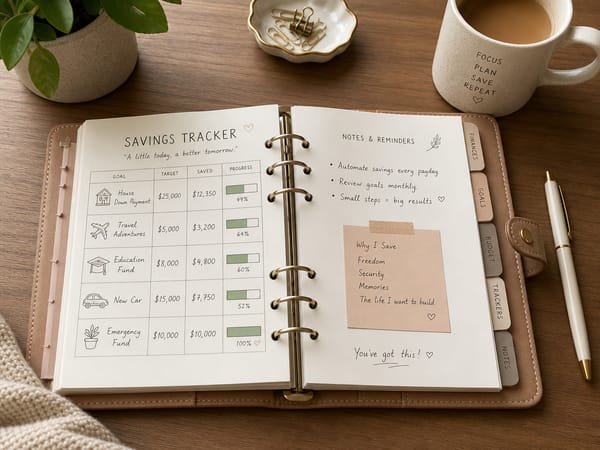
Somake prompt:
Open planner showing a savings tracker with goals filled in, coffee mug beside it, desktop flat lay, organized and calm, warm tones, soft daylight
Halfway check: If you've been skimming since the Finance section, that's normal — the categories start to blend. Before continuing, pick one idea from Health or Career that made you actually pause. That's your anchor image. The rest of the board builds around it.
Relationships & Love Ideas
This section covers more ground than romance. Relationships include friendships, family, and community.
A photo of you and your closest friends — or the type of friendship you want to cultivate
A family goal: a trip you want to take together, a tradition you want to start, more regular dinners
For romantic relationships: something that captures how you want to feel — safe, playful, chosen — rather than a generic couple photoshoot
A phrase that represents your intention: "present," "connected," "boundaries respected," "chosen family"
An image of a community you want to belong to: a running club, a book group, a creative collective
A specific recurring moment: "Sunday dinners," "weekly calls with mom," "monthly friends night"
If you're single and building toward partnership, images representing the feeling of that relationship often resonate more than idealized photoshoots.

Somake prompt:
"Two close friends laughing at a dinner table, candlelight, warm amber tones, genuine joy, wine glasses, cozy restaurant atmosphere, candid moment"
Personal Growth & Mindset
This is the most underrated category. Most boards load up on outcomes — the job, the body, the house — and skip the inner work required to get there.
Personal growth images should represent who you're becoming, not just what you're acquiring.
A "future self" visual — someone representing the version of you you're growing into: calm, creative, grounded, confident
A skill or learning goal: a language, an instrument, a certification
A phrase that captures your year's mindset: "slow is smooth," "consistency over intensity," "I trust the process"
A reading goal with specific titles, not a generic pile
A "letting go" image: something representing a habit, relationship, or belief you're releasing
A boundary or self-care intention stated plainly: "no screens after 9pm," "therapy every two weeks"
A mentor or figure whose approach you're studying — not idolizing, studying
A daily practice image: meditation, journaling, a morning walk
The science side: identity-based goals outperform outcome-based goals in long-term follow-through. "I am someone who prioritizes sleep" lands deeper than "I want to sleep more." Let this section reflect that shift.
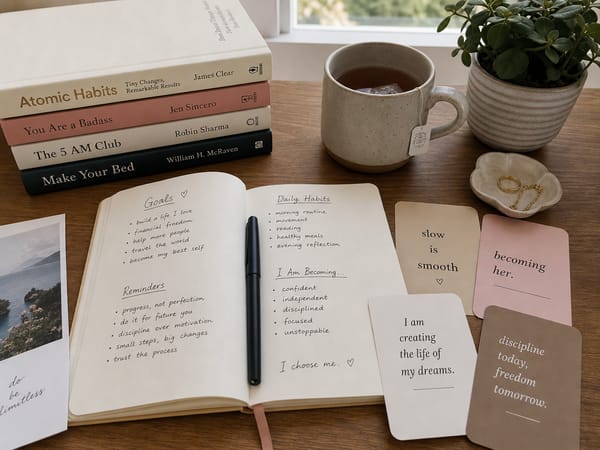
Somake prompt:
Personal growth vision board flat lay — open journal with handwritten goals, stack of four books with visible spines, ceramic mug with tea, small potted plant, affirmation cards with phrases like 'slow is smooth' and 'becoming her', wooden desk surface, soft diffused window light, calm and intentional mood
Travel & Adventure Ideas
Travel boards work best with layering — multiple images of the same destination — and with specificity.
One "destination of the year": several images of that place — the food, the landscape, a street, the vibe
A local adventure bucket list: trails, cities, or experiences within a day's drive
A travel feeling image: freedom, spontaneity, openness — a packed bag, an open road, a departure board
A cultural experience: a cooking class, a festival, a language exchange
A trip type you want to prioritize: solo, couple, family, friends group
A travel habit: "one new country per year," "a weekend trip every quarter"
You don't need an international trip for this section to count. A first solo weekend or a road trip through a new region is equally valid.
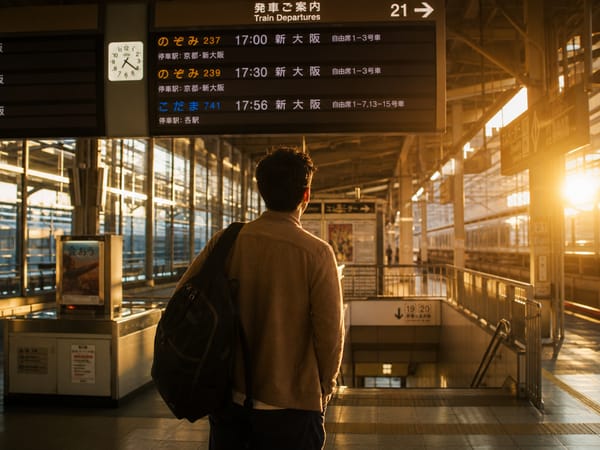
Somake prompt:
Solo traveler at a Japanese train station, backpack over shoulder, looking at a departure board, golden hour light through station windows, editorial travel photography style
Home & Lifestyle Ideas
This section isn't about redecorating. It's about the feeling of your daily environment.
An image capturing your ideal morning: coffee, light, quiet, no notifications
A specific home goal: "reading corner," "organized pantry," "no-phone bedroom"
The energy of a room you want to create — a color palette, a mood, a sense of space
A phrase describing how you want your home to feel: "calm," "creative," "welcoming," "mine"
A rhythm or ritual: "slow Sundays," "dinner at the table," "no work after 7"
Keep this section small. A few well-chosen images beat a renovation fantasy.
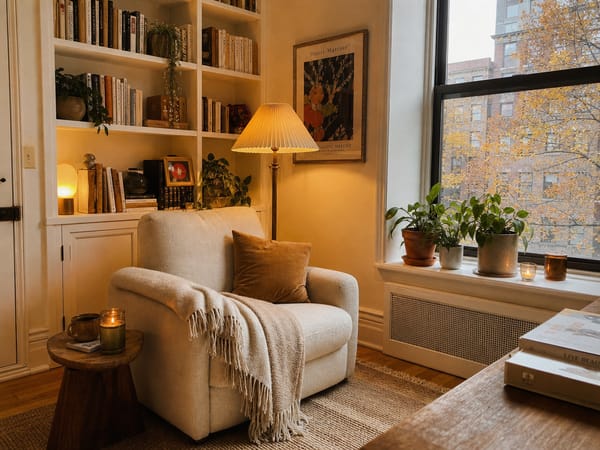
Somake prompt:
Cozy reading corner in a small apartment, built-in bookshelves, warm floor lamp, linen armchair, plants on windowsill, autumn afternoon light, hygge aesthetic
Already have a photo of your current space? You can restyle it into your target aesthetic → instead of starting from scratch.
Creativity & Personal Projects
Often skipped, always regretted. If you have something you've been wanting to make, build, or start — it belongs on your board.
A creative project with a deadline: "finish the screenplay by June," "launch the Substack"
A medium or craft you want to explore: ceramics, film photography, watercolor, music production
A creative environment image: a studio, a workshop, a dark room, a recording setup
An audience or output image: a published book, a finished product, a performed piece
A creative collaboration: a band, a writing group, a co-founder
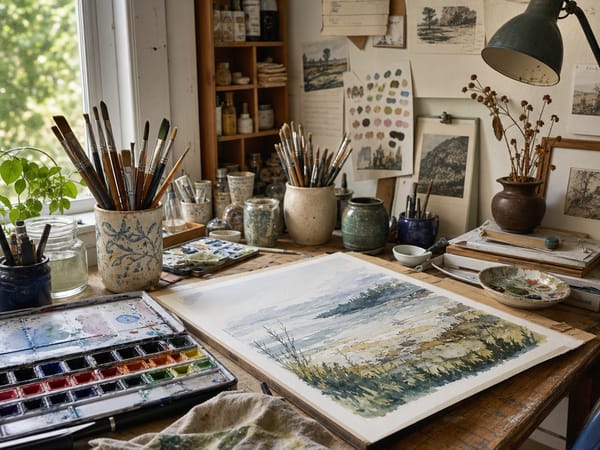
Somake prompt:
Artist's studio desk with watercolor paints, brushes in ceramic cups, in-progress painting, natural north light, creative mess, warm and inspiring atmosphere
Vision Board Titles
A title does something subtle but important: it gives your board an identity, not just a list. When you name your vision, you start to inhabit it.
Manifestation-coded:
"It's Already Done"
"Calling It In"
"The Life I'm Claiming"
"Watch Me"
"Already Becoming"
Ambition and hustle:
"My Best Year Yet"
"Level Up"
"Doing the Work"
"Building It"
"No Shortcuts, No Excuses"
Soft / aesthetic:
"Her Chapter"
"Becoming Her"
"In Her Era"
"Soft Life, Strong Goals"
"That Girl. This Year."
Identity-based:
"Who I'm Becoming"
"She Did It"
"My 2026 Self"
"The Main Character"
"New Season. Same Me, But Better."
"Living Like Her"
Neutral / universal:
"2026 Vision"
"The Life I'm Building"
"This Is the Year"
"On Purpose"
"My Next Chapter"
Student / academic:
"Honor Roll Energy"
"My Future Starts Now"
"Graduating Into It"
"Class of [Year]: Ready"
"Earning It"
The best titles feel like something you'd say about yourself at the end of the year, looking back.
Still can't choose? Pick the one that makes you feel slightly uncomfortable — that edge usually means it's closer to where you actually want to go, not where you already are.
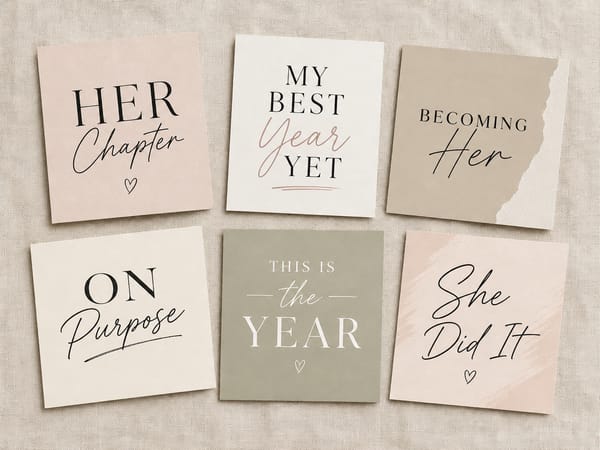
Somake prompt:
Six vision board title cards arranged on a neutral linen background — mix of handwritten and printed styles, varying fonts from bold serif to delicate script, titles include 'Her Chapter', 'My Best Year Yet', 'Becoming Her', 'On Purpose', 'This Is the Year', 'She Did It', pastel and neutral color palette, flat lay with soft shadows
Vision Board Ideas for Students
Student boards work differently from adult boards in one key way: goals need to be achievable within an academic year, not a life span.
Boards connected to this semester's reality get used. Boards full of 10-year fantasies get shelved.
From Vague Idea to Vision Board Image
The problem most students hit: they know what they want, but don't know how to turn it into something visual. Here's the three-step conversion:
| Vague idea | Specific goal | Vision board image |
|---|---|---|
| "I want better grades" | "GPA 3.8 this semester" | Styled report card with 3.8 highlighted |
| "I want to get an internship" | "Tech internship offer by May" | Company logo + offer letter style graphic |
| "I want to be healthier" | "Sleep by 11pm, gym 3x/week" | Habit tracker with checkmarks |
| "I want to be more confident" | "Join debate club, speak at one event" | Someone at a podium, small audience |
| "I want to travel after graduation" | "Interrail Europe — August 2027" | Train map with a route marked |
Academic goals:
A specific GPA target: "3.8 this semester" — written large, not vague
The college or program you're working toward — name, logo, campus photo
A subject goal: "AP Chem: 4 or 5," "write one strong essay per week"
An honor, award, or team you want to make
Personal development:
A skill outside class: coding, photography, a language, an instrument
A leadership role: student government, club president, team captain
A habit: "8 hours sleep," "phone off during study sessions," "library every Tuesday"
Future and career:
An internship type or company you're researching
A field of study you're still deciding on — put both options up, let the board help you choose
A professional you'd like to connect with
Life goals:
A friendship or community you want to be part of
A sport or physical goal
Something to do before graduation — a trip, a performance, a milestone
For classroom use: let students keep boards private or share only one item. Boards made for display become performative — and that defeats the point.
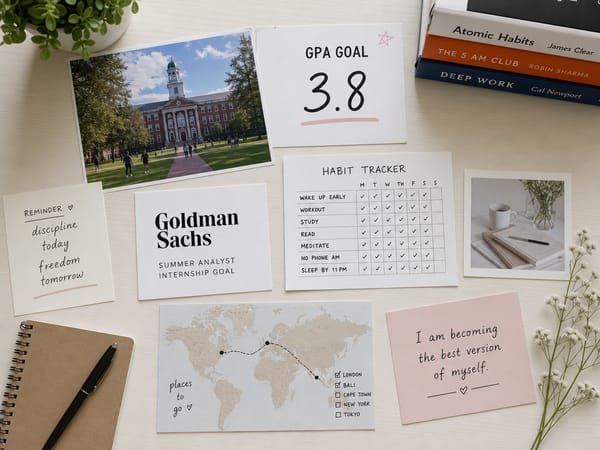
Somake prompt:
Student vision board flat lay on a light desk — college campus photo, GPA goal card reading '3.8', internship company logo printout, habit tracker with checkboxes, small map with a travel route marked, book stack, affirmation card, clean organized layout, top-down view, natural light, academic aesthetic
How to Find Images
The Traditional Method
Cut from magazines. Print from Pinterest. Use your own photos. This still works — the tactile process helps some people engage more deeply.
The limitation: the images you find rarely match what you're actually visualizing. That stock "dream home" looks nothing like the neighborhood you have in mind. The "fitness inspiration" photo is someone else's body at someone else's gym.
The AI-Generated Method
AI image generators let you describe exactly what you want and get an image that matches your specific vision — not one someone else chose.
This matters because vision boards work through emotional resonance. An image that feels like your future lands differently than a recycled Pinterest photo you've seen a hundred times.
Writing Prompts That Work
The most common mistake: prompts that are too vague. Vague prompts get generic images. Specific prompts get images that actually resonate.
| Too vague | Specific and effective |
|---|---|
| "healthy lifestyle" | "Woman meal prepping on Sunday afternoon, organized glass containers, colorful vegetables, clean bright kitchen, natural light, calm energy" |
| "dream home" | "Cozy reading corner in a small apartment, built-in bookshelves, warm lamp, linen armchair, plants on windowsill" |
| "career success" | "Woman speaking confidently on a stage, spotlight, small TEDx-style audience, blazer, modern auditorium" |
| "financial goals" | "Open planner with savings tracker, filled-in numbers, coffee beside it, morning desk, organized and calm" |
| "travel" | "Solo traveler on a train platform in Japan at golden hour, backpack, departure board overhead" |
Once you have a prompt that feels right, get the image in seconds → — no scrolling through stock photos, no settling for someone else's version of your goal.
The practical workflow:
Write your goal in one sentence
Turn that sentence into a specific visual scene — who, where, what, lighting, mood
Generate 2–3 variations
Choose the one that gives you a genuine gut reaction — not "that's nice," but "yes, that's the one"
Somake prompt:
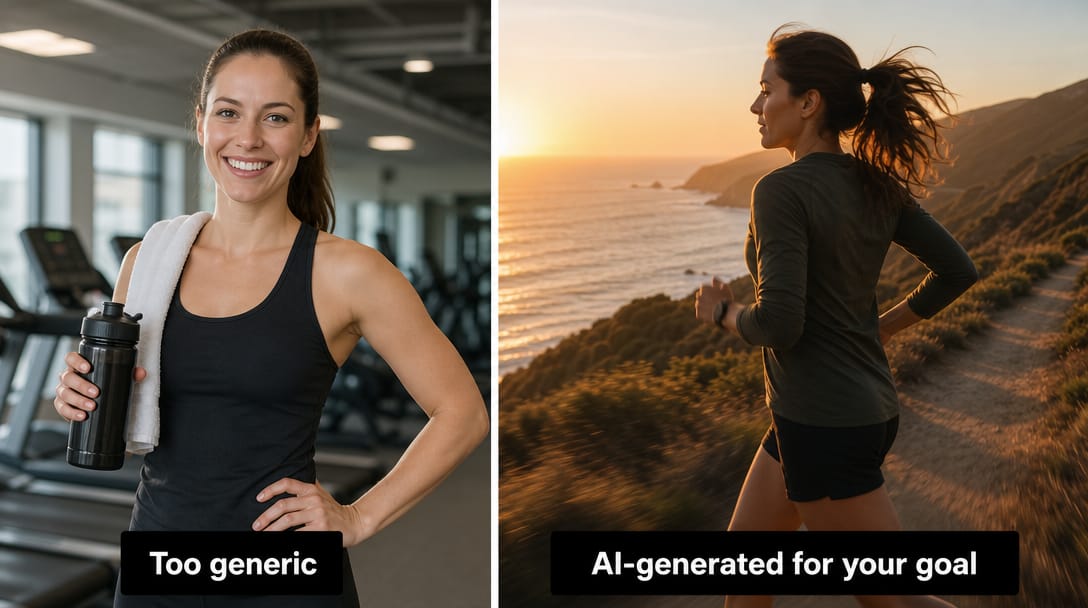
Split-frame comparison image — left side shows a generic stock photo of a woman at a gym with flat lighting and forced smile, labeled 'Too generic'; right side shows a woman running on a coastal trail at golden hour, motion blur, cinematic light, deeply personal mood, labeled 'AI-generated for your goal' — clean white divider between the two frames, editorial layout
5 Rules for Boards That Work
1. Keep it under 12 goals. More creates visual noise and decision paralysis. Go deep on fewer items.
2. Put it where you'll actually see it. Phone wallpaper means multiple views per day. A folder means zero. The board only works if you see it.
3. Use personal photos when possible. A photo of you at a trail you love works harder than stock hiking imagery. Your brain recognizes you in it.
4. Include process images, not just outcomes. A photo of you writing is more actionable than a bestseller badge. Show yourself doing the work, not just having arrived.
5. Revisit it monthly. Goals shift. Life changes. A board that no longer fits is dead weight. You're allowed — encouraged — to update it mid-year.
Quick Reference
| What you want | What to do |
|---|---|
| Know where to start | Answer the 3 questions in the "Which Categories" section |
| Find your images | Use the prompts in each section, then generate in seconds |
| Pick a title | Choose from the 30 options by vibe |
| Build a student board | Use the vague → specific → visual table |
| Make it work long-term | Follow the 5 rules, especially: keep it visible |
Start Here — Right Now
Reading about vision boards is the procrastination version of making one. Here's the three-step version you can do today:
1. Pick your top 2 categories. Not six. Two — the ones where the gap between where you are and where you want to be feels most urgent.
2. Write one specific goal for each. Not "be healthier." Not "do better at work." A real sentence with a number, a date, or a name in it.
3. Generate your first image. Take that goal, turn it into a visual scene description, and get the image in seconds →. If it gives you a gut reaction — good. That's what a vision board image is supposed to do.
Everything else — the other categories, the title, the layout — you can add later. The board that exists beats the perfect board you're still planning.